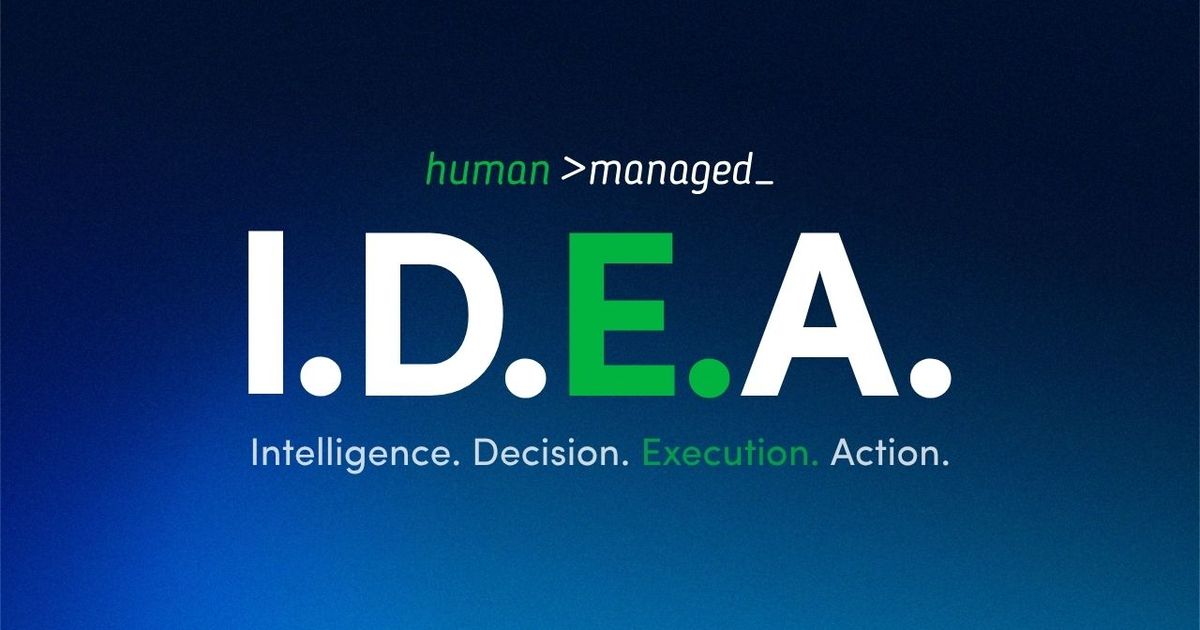
Singapore, 3 June 2026 — Human Managed has updated its I.D.E.A. (Intelligence, Decision, Execution, and Action) operational response framework so that every response path includes explicit execution planning before work is recorded as completed action.
The change targets a gap the company saw in its own service delivery and in customer operations: teams would make sound decisions and align on direction, then spend the following weeks defining steps, owners, timing, and rollback. By the time a plan existed, the situation had often changed or the response window had closed. Human Managed describes the accumulated delay as decision debt.
Execution, in this model, is what sits between deciding and doing: steps, owners, timing, checkpoints, and rollback. Without that layer, a decision remains a recommendation.
Human Managed is implementing the framework with modular AI systems and agents, not as a productivity layer on existing workflows but as the operating structure for how responses run. Each stage has a defined output:
Intelligence — What changed, why it is elevated, and what normal looks like. Output: a grounded explanation with reference baselines.
Decision — What response paths exist, their trade-offs, and which path fits. Output: ranked decision options with explicit trade-offs.
Execution — What the plan is: steps, owners, timing, checkpoints, and rollback. Output: an execution plan with a rollback procedure.
Action — What was done and with what receipt. Output: an action receipt with a unique identifier and a side-effects record.
Every stage is logged. The full chain is replayable. When an operator or auditor asks why the system took a given path, the answer is meant to be traceable reasoning, not an ungrounded model assertion.
"Good decisions don't create outcomes. Executed decisions do," said Karen Kim, Chief Executive Officer, Human Managed. "We built execution into I.D.E.A. because our customers and our own teams were losing time after the decision was already made. The framework is how we carry operational responsibility through to the outcome — accountable, explainable, and operational."
"When someone asks why the system did what it did, there should be a reasoned answer, not a confident hallucination," Kim added.
Human Managed positions the update as part of its direction as an AI-native service operator: systems that do not only surface information but hold responsibility for how work moves from signal to completed action.
Organizations that want to learn how the framework applies across cyber, risk, and digital operations can visit humanmanaged.com or request a briefing at humanmanaged.com/request.