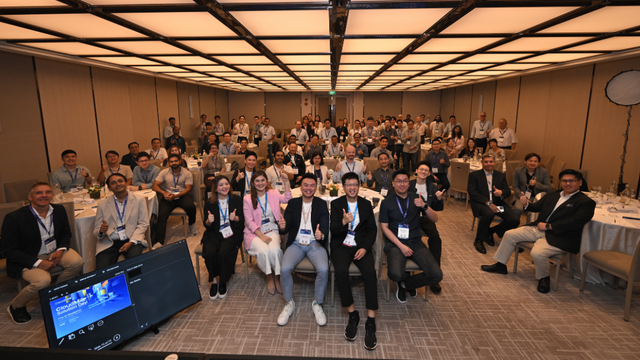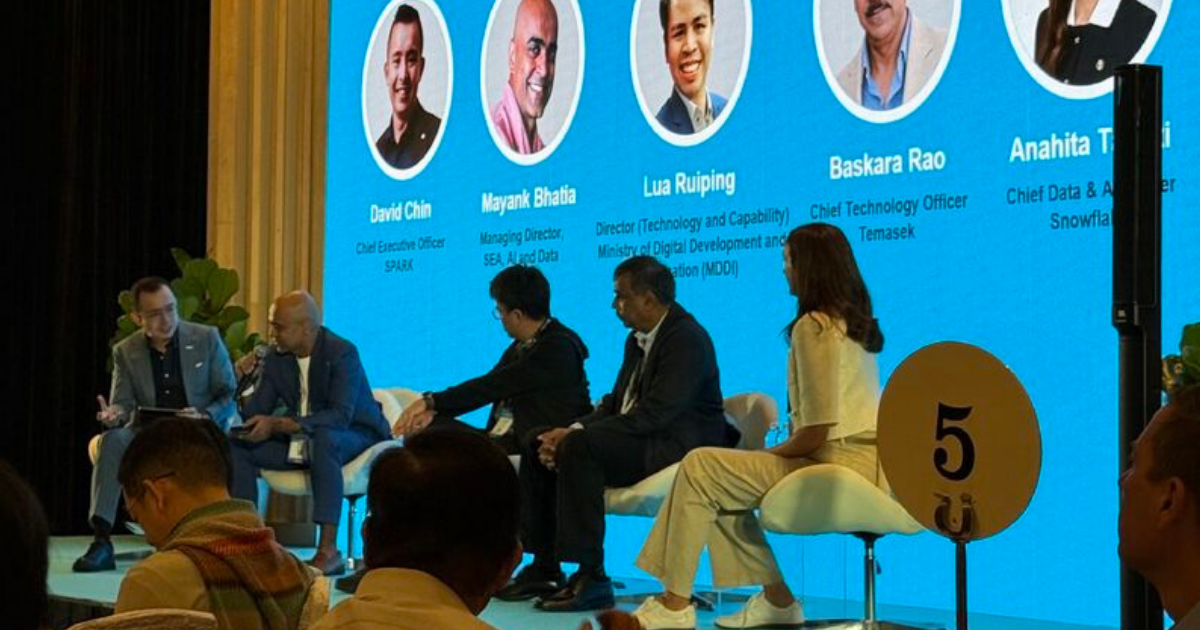
Karen Kim, our CEO, spent the day at Snowflake World Tour Singapore, held August 26 at Sands Expo and Convention Centre under the theme "Making AI Real for Business." A lot of the discussion kept landing on the same point: AI adoption cannot be separated from operating model transformation. You cannot introduce agents that take actions without rethinking how decisions, accountability, and governance work around them.
Familiar problems, higher stakes
A panel featuring Ruiping Lua, Baskara Rao, Mayank Bhatia, Anahita Tafvizi, and David CK Chin moved past what AI agents can technically do and into what actually slows enterprise adoption down. The list was familiar: fragmented data ownership, unclear accountability, siloed decisions, governance that lives in a document instead of being built into the system itself, and evaluation frameworks that stop checking once something ships.
None of that is new. What's changed is the cost of leaving it unresolved. When a human is in the loop for every decision, a governance gap is an inconvenience. When an agent is making the decision and taking the action, the same gap becomes the failure mode.
Good once isn't good forever
Ruiping Lua made a point worth sitting with: evaluation can't be treated as a gate you pass before production and then forget. For AI, being good once doesn't mean staying good. The work is to define what "good enough" means for a specific use case, keep evaluating it continuously once it's live, and build the incident, recovery, and learning loops that catch it when performance changes.
That's a different discipline than most organizations are set up for. A launch checklist assumes the hard part is behind you once you ship. Continuous evaluation assumes the hard part never really ends.
Trust, not intelligence, is the constraint
Baskara Rao's framing connected directly to that: model intelligence is becoming table stakes. What actually determines whether an enterprise can move faster is whether it trusts the data and context feeding the system, the decisions the system makes, and the recovery path when something goes wrong.
That's three separate kinds of trust, and most conversations about AI adoption only address the first one.
Six questions before you hand over the decision
As agents take on more of the execution and decision-making layer, the panel's shared thread was that enterprises need to be deliberate about six things: the outcome they're trying to reimagine, the data and context required to support it, who owns the business outcome, what the system is allowed to decide, how those decisions get evaluated once they're in production, and what happens when something goes wrong.
That list maps closely to how we think about the problem at Human Managed. It's close to the reasoning behind our own I.D.E.A. framework: intelligence has to be grounded in real operational data before a decision gets made, and every decision needs a clear line to the execution and action that follows it, with someone accountable the whole way through.
What AI actually exposes
Mayank Bhatia put the sharpest point on the day: AI will not create your data strategy for you, and it will not repair your operating model either. What it will do is make the weaknesses in both impossible to ignore.
That's close to what we mean when we say machine run, human managed. The system can carry the execution. It can't carry the accountability for what it was asked to do, or own the consequence when the answer turns out to be wrong. That part stays with the people running the business, whether or not the org chart has caught up to that yet.
What this means for us
Snowflake World Tour didn't hand Human Managed a new argument. It handed back a sharper version of the one already built into how we work: governance that lives in the system rather than the policy binder, evaluation that never stops once something ships, and clear ownership of the outcome before an agent ever touches the decision. Thank you to Snowflake for another genuinely useful day, and to the panel for pushing the conversation past what's possible and into what actually has to be true first.