Most security teams aren't short on data. They're short on a picture.
Every alert has a source. Every source has its own console. An endpoint detection tool fires on one thing. The identity platform fires on something else. The cloud security posture product gives you a different number. And when a CISO needs to walk into a board meeting and answer "are we secure?", the honest answer is usually: it depends on which tool you're looking at.
That is not an acceptable answer. And it is not an inevitable one.
On 1 July 2026, we're launching invicta.io (our cybersecurity workbench) officially, to the market. This post explains what it does, why we built it the way we did, and what we think it changes.
The problem with security scores
Security scores are not new. Most enterprise tools produce one. The problem is that most of them don't show their work.
A score of 72 or "elevated" tells you something is wrong. It does not tell you what is driving it, how much of your environment the number actually reflects, or whether an improvement last week was real progress or just noise. Without that context, a score is barely more useful than an alert.
We built invicta.io around a different premise: a security score is only useful if you can see exactly what is driving it and act on what you find.
Three metrics, three different questions
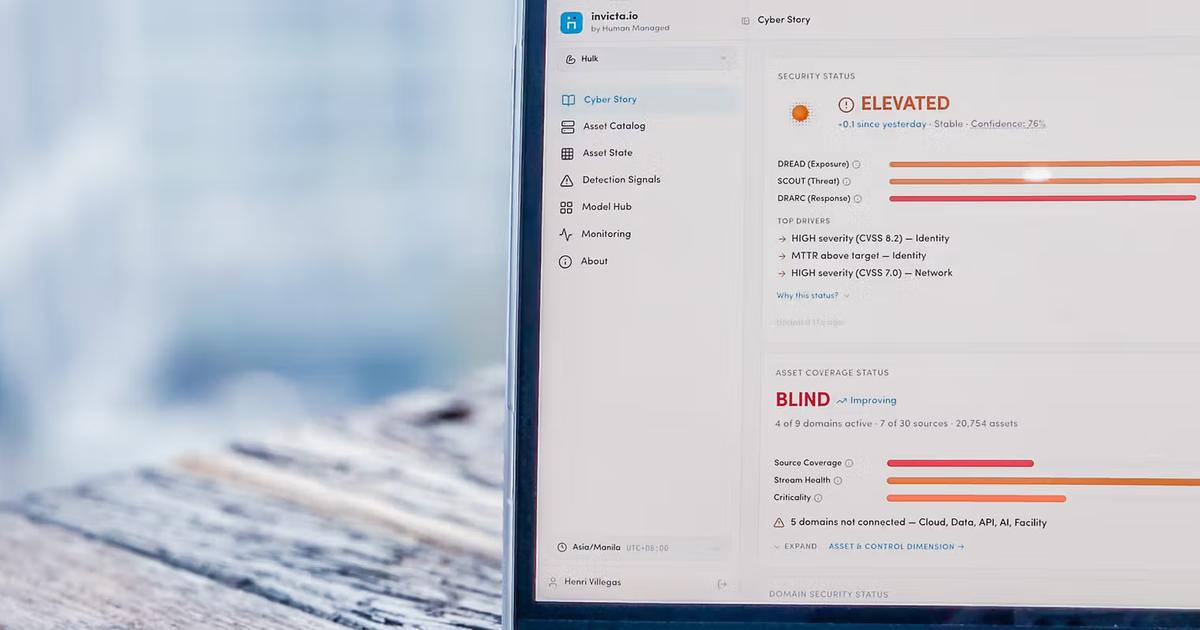
The dashboard at the heart of invicta.io is called Cyber Story. It produces an overall security score, but that score is built from three distinct metrics that answer three distinct questions about your environment.
DREAD answers: how exposed are we? It scores your posture and exposure across five dimensions: damage potential, exploit reproducibility, exploitability, affected asset scope, and discoverability. Each dimension is weighted by asset criticality, privilege level, and current exploit intelligence. Two organizations can have the same vulnerability count and very different DREAD scores, because the risk is not in the volume of issues. It is in what they are connected to and how hard they are to exploit.
SCOUT answers: how much threat pressure are we under right now? It captures active detection activity across severity, confidence, occurrence, uptake, and threat intelligence alignment. DREAD and SCOUT measure different things. An environment can be well-patched and still be under significant threat pressure. You need both pictures.
DRARC answers: how effective is our response capability? It scores mean time to detection, mean time to response, automation coverage, recovery efficiency, and containment effectiveness, checked against your SLA targets, not an external benchmark that may not fit your business. That distinction matters. A 4-hour mean time to respond might be excellent in one context and a policy breach in another.
Together, the three metrics explain not just where your score is. They explain why.
The confidence score is not a footnote
Alongside the overall security score, Cyber Story displays a confidence rating. In early deployments, organizations typically see this number sit somewhere in the 60s–80s when several domains are not yet connected.
We put that number front and centre deliberately.
A security score calculated from 40% of your environment is not a security score. It is a partial read. Presenting it without the confidence rating hides what your team most needs to know: how much you can actually trust what you're seeing.
The nine domains invicta.io connects across are: identity, network, endpoint, application, cloud, data, API, AI, and physical infrastructure. Every domain you add improves coverage. Every gap shows up in the confidence score rather than disappearing into a clean-looking number that obscures what you can't see.
We think this is the honest way to build a security platform. We also think it is the more useful one. Teams can't prioritize coverage improvements they can't see.
From aggregate to individual asset in one view
Cyber Story doesn't stop at the aggregate. It breaks down to domain level (each connected domain gets its own DREAD, SCOUT, and DRARC scores) and then down to individual assets.
Critical assets that need immediate attention are flagged directly. In early deployments, one common finding is assets that have been sitting in a critical state for two weeks or longer. These are not missed alerts. They are missed priorities: items that were visible somewhere in a tool but never came up at the right level of urgency for someone with the authority to act.
The 14-day trend chart shows how each metric has moved over time. This matters when you are trying to answer whether a recent change actually improved your posture or just shifted the problem somewhere else.
The question your board is actually asking
We have spent a long time watching security briefings. The question that comes up most often, from boards to regulators, is not "how many alerts did you triage this week?" It is: "are we secure?"
That question deserves a real answer. Not a slide deck assembled from six different tools. Not a number without the reasoning underneath it. An answer that shows the posture, the coverage behind it, what's driving it, and what comes next.
invicta.io is built to make that answer possible: for the analysts running the platform and for the executives who need to understand it. An AI assistant explains what is driving any part of the score in plain language, so the answer does not require someone to translate between tools.
What changes when you have the picture
Having your security posture in one coherent view changes the questions you can ask.
You stop correlating data across eight separate products and read one view. "Elevated" means the same thing in every context, because it comes from one calculation. Instead of presenting a vulnerability count and hoping it resonates, you are showing a trend, the confidence behind it, and the specific assets that need to move first.
That is the operational change invicta.io is designed to make.
What's next
The Cyber Story overview is the start. Over the coming weeks, we will be going deeper into individual features: asset state, domain-level SecOps, Detection State Diagnosis, and more. Each video in the series covers a specific part of the platform and how it works in practice.
If you want to see how invicta.io reads for your environment, reach out. We'll show you what your picture looks like.
invicta.io is part of the Human Managed operational intelligence platform.